When we talk about the “Old World” versus the “New World,” it is easy to assume that every country in Europe has been around for a thousand years, while nations across the Americas are the relative newcomers.
Culturally and archaeologically, Europe certainly boasts ancient roots. However, when you look at modern sovereign statehood—the actual dates these nations unified, wrote their modern constitutions, or broke free from empires—a surprising truth emerges: dozens of European countries are actually younger than the United States (1776), and even younger than most Latin American republics!
While nations across Latin America were forging their independence in the early 1800s—such as Haiti (1804), Colombia and Argentina (1810–1816), Mexico and Peru (1821), and Brazil (1822)—many of Europe’s most famous countries were still divided kingdoms, imperial provinces, or territories ruled by neighboring powers.
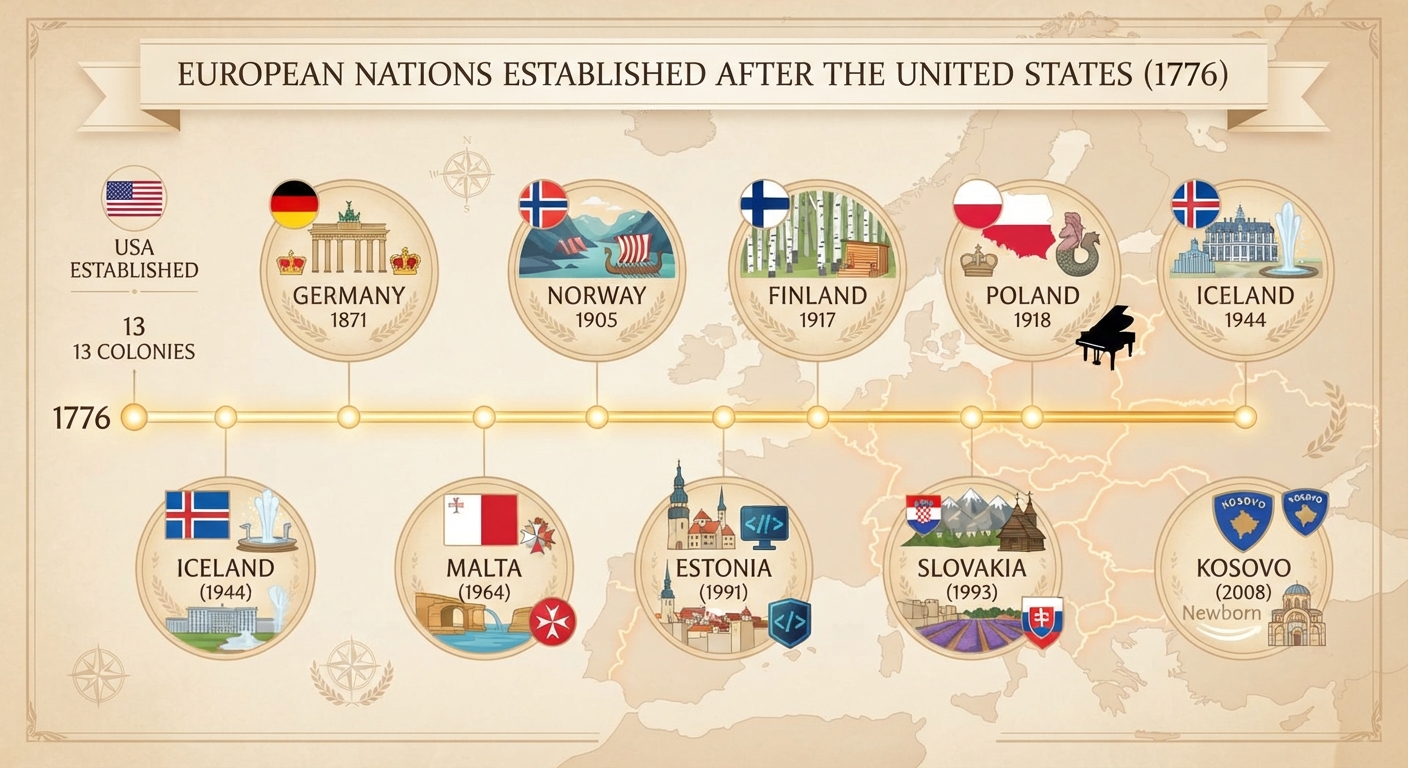
Here are 10 prominent European nations that achieved their modern statehood after the United States—and in every single case, after the great wave of Latin American independence.
1. Italy (1861)
Long before the 19th century, the Italian peninsula was a patchwork of competing kingdoms, duchies, and Papal States. It wasn’t until the Risorgimento movement that Giuseppe Garibaldi and King Victor Emmanuel II unified the region into the modern Kingdom of Italy on March 17, 1861—roughly 40 years after Mexico, Central America, and South America broke away from Spain and Portugal.
2. Germany (1871)
For centuries, German-speaking Europe consisted of dozens of independent kingdoms, principalities, and free cities. Chancellor Otto von Bismarck finally engineered the unification of the modern German nation-state on January 18, 1871, making unified Germany nearly a full century younger than the United States.
3. Norway (1905)
Although Norway has deep Viking-era roots, it spent centuries in political unions with Denmark and later Sweden. Norway peacefully dissolved its union with Sweden on June 7, 1905 (ratified in October 1905), establishing itself as a fully independent modern kingdom.
4. Finland (1917)
Ruled for centuries by Sweden and subsequently as an autonomous Grand Duchy within the Russian Empire, Finland seized the opportunity following the Russian Revolution to declare full independence on December 6, 1917.
5. Poland (1918) (Restored)
Poland boasts a proud medieval kingdom dating back to 966 AD, yet it was completely erased from the map of Europe for 123 years after being partitioned by Russia, Prussia, and Austria. Poland reclaimed its modern independence on November 11, 1918, at the close of World War I.
6. Austria (1918)
While the Habsburg dynasty ruled a massive European empire for centuries, the modern nation-state of Austria was born on November 12, 1918, following the collapse and dissolution of the Austro-Hungarian Empire at the end of World War I.
7. Ireland (1922)
After centuries of British rule and a fierce struggle for self-determination, the Irish Free State was established in December 1922 following the Anglo-Irish Treaty, later adopting its modern republican constitution in 1937.
8. Iceland (1944)
Iceland is home to the Althing, one of the world’s oldest surviving parliaments (founded in 930 AD). However, the island remained under Norwegian and Danish crowns for centuries before formally proclaiming itself a fully independent republic on June 17, 1944.
9. Malta (1964)
Sitting at the strategic crossroads of the Mediterranean, Malta was governed by the Knights of St. John, France, and the British Empire before gaining its modern independence from the United Kingdom on September 21, 1964.
10. Slovakia (1993)
Following the fall of the Iron Curtain, Czechoslovakia peacefully split into two separate nations in what became known as the “Velvet Divorce.” Slovakia—alongside the Czech Republic—emerged as an independent sovereign state on January 1, 1993.
Why This Matters for Understanding World History
History often looks different depending on where you stand on the map. While Europe is rightfully celebrated for its ancient cities, art, and traditions, its modern political borders are surprisingly young. In fact, Latin America’s republics are among the oldest continuous constitutional democracies in the world—predating the modern unified nations of Germany, Italy, and much of Central and Eastern Europe by decades.
Leave a Reply